Hawlwadig Road
Black Hawk DownHawlwadig Road, the paved north-south avenue running past the Olympic Hotel in Mogadishu, became the ground-level center of the raid and the fighting that spread through the surrounding neighborhood. Its narrow dirt alleys and crowded intersections connected the target house to homes, shops, and the wider city, making the road both an approach to the objective and a perilous corridor for soldiers and civilians.
Setting and Approach
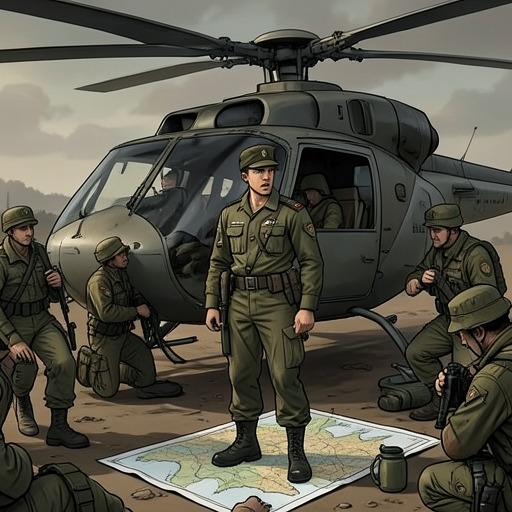
In the afternoon sun, sand drifting across Hawlwadig Road’s intersections turned rust-orange. The Olympic Hotel, a five-story white building and one of the few large structures still intact in the city, stood beside the avenue; three blocks west lay the crowded Bakara Market. One block north of the hotel, across the road, stood Mohamed Hassan Awale’s Target House: an L-shaped building with a high-walled courtyard, three stories at the rear and two at the front. Cars, pedestrians, and donkey carts moved along its frontage as the raid began. At 3:43 p.m., two Little Bird helicopters made an initial pass over the target. After finding no apparent trouble, four more Little Bird helicopters descended toward Hawlwadig Road, vanishing into swirling dust as commandos jumped out and stormed the house. Black Hawk helicopters carrying United States Army Rangers followed. Staff Sergeant Matt Eversmann’s aircraft hovered above the brown dust while waiting for the others; from his position, the delay made the stationary helicopter feel dangerously exposed, and gunfire was already audible beneath the engines and rotor noise.
A Road Under Fire
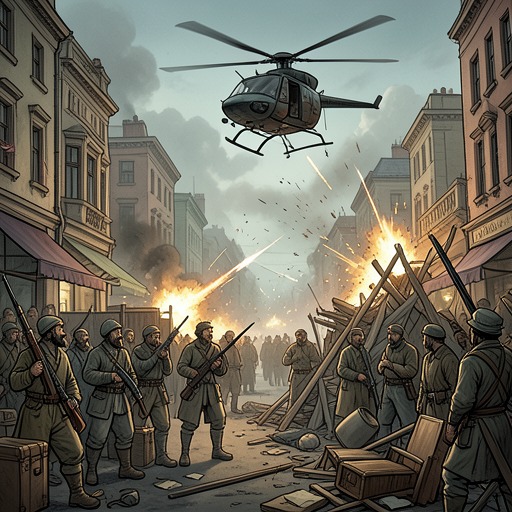
The road quickly ceased to be a clear route from the landing point to the objective. Eversmann’s Chalk Four had roped down north of its intended position, a block from the northwest corner of the target block. Blackburn’s fall from the helicopter and the unexpected volume of gunfire made the planned walk down Hawlwadig Road impossible. The Rangers instead found themselves pinned in the avenue’s exposed intersections, with alleys offering cover to the armed men firing at them.
Eversmann saw crowds farther up the road to the north, while nearer attackers darted between alleys, shooting and retreating as they approached the Americans’ positions. The Rangers had been ordered to fire only at people pointing weapons at them, but armed men were intermingled with women and children, and residents crowded into the streets to watch the disturbance. The book connects that civilian presence not only to the immediate difficulty of identifying targets but also to the hostility that months of Ranger missions had stirred across the city.
The pressure on the road intensified in bursts. Men emerged with AK-47s, fired, and took cover; rocket-propelled grenades flashed from launchers and wobbled toward the Rangers before exploding in flame and concussion. Eversmann had expected resistance, but not a wave of fire so forceful that its noise and energy seemed to arrive visibly down the avenue. When a Black Hawk passed overhead, he stood and gestured north toward the gunmen. Its crew chief fired the minigun along the street, and the shooting from that direction stopped for several minutes.
The avenue’s danger extended beyond the immediate exchange of fire. In the moving convoy, a woman in a purple robe ran beside a truck carrying a baby; when she turned and raised a pistol, Specialist Eric Spalding shot her, then fired four more rounds as she fell. The truck was moving too fast for him to see whether the infant had been hit, and he feared that it had. On Hawlwadig Road, the presence of a child did not settle what a person was doing, while the sight of a weapon did not erase the human cost of firing. The road’s crowds and crossfire made that distinction a moment-by-moment crisis rather than an abstract rule.
Homes and the Civilian View
Hawlwadig Road was also a boundary between the assault on the target house and the homes caught in its fire. Ali’s family lived diagonally across the road from Mohamed Hassan Awale’s Target House. As Rangers descended on ropes and began firing, a helicopter swept low and fired from its side; Ali’s youngest brother, Abdulahi Hassan Mohamed, was killed by the family’s gate. Ali fled through streets crowded with terrified women and children, dead people and animals, while militiamen with megaphones urged residents to come out and defend their homes. A member of a neighborhood militia formed to protect local shops from bandits, he retrieved an AK-47 hidden at a friend’s house, returned to his shop, and fired at the Rangers from behind a building. When the first helicopter crashed, he and his armed friends shifted north, moving between cars and buildings to shoot and take cover. Their account makes the avenue not simply a military route but a lived neighborhood in which people’s homes, shops, and local defenses were drawn into the battle.
The crash also reached beyond the road into the courtyard of Abdiaziz Ali Aden’s family home. The aircraft struck the roof and came down in an alley, bringing part of the house down on Aden’s parents and eight brothers and sisters. He feared they had been killed, but found them trapped beneath a sheet of tin and helped pull the roof away. The family ran to a friend’s house, afraid the wreckage might explode; when Aden returned, he found the wall reduced to stones and dusty mortar. He stayed to guard the damaged home, a practical necessity in a city where an open, undefended house could be looted. The wreck’s immediate danger thus continued as a domestic aftermath: rescue, flight, and the effort to hold on to a house already broken by the fighting.
Later that night, the road’s violence was visible in the burden carried away from it. Kassim Sheik Mohamoud’s burial party brought the bodies of two employees toward a cemetery as gunfire continued across the city. Near dusk, a helicopter swooped low enough to make the bearers drop the bodies and run for a wall; after it passed, they returned and picked them up. They had to flee once more when another helicopter buzzed down as they began digging. Hawlwadig Road and its surrounding streets therefore remained dangerous even for people trying to perform the urgent work of burial: the battle’s reach was measured not only in the exchange of fire, but in the interrupted passage of the dead and the living.
Beyond the Avenue
The danger spreading from Hawlwadig Road reached people who had not joined the fighting. After an hour of shooting, Abdikarim became restless and ventured out to learn what was happening near the market, where relatives lived. He found dead men, women, and children in the road, and an American soldier wounded in the leg, lying beside the street and trying to hide. When a woman ran in front of him, the soldier fired in their direction; she was hit but managed to get off the street. A Little Bird helicopter then flew low down an alley, firing as bullets kicked dust along the stone wall beside Abdikarim. He decided that coming out had been a mistake, retreated to a friend’s house, and spent the night on the floor with others while gunfire continued. His brief attempt to seek news instead exposed how little distinction the street offered between a witness, a casualty, and someone caught in a line of fire.
The fighting also overwhelmed hospitals far from the immediate intersections. At Volunteer Hospital, near the American base, surgeon Abdi Mohamed Elmi and his colleagues had initially seen few wounded: roadblocks were burning, helicopters were flying low and shooting, and many residents were afraid to venture out. By October 4, however, all 500 beds were occupied, with at least 200 additional wounded in the hallways; Digfer Hospital received even more. Many patients had gut wounds, and delays in reaching care allowed infections to take hold when the hospital had too little antibiotic medicine to treat them successfully. Elmi worked through the night with six other surgeons in the hospital’s three-bed operating theater, assisting in 18 major operations by sunrise as more patients continued to arrive. The crowded roadways around the battle had become part of the medical crisis: they delayed the wounded on their way to care, while the volume of casualties kept filling the wards.